How to Read Your Prescription Med Label
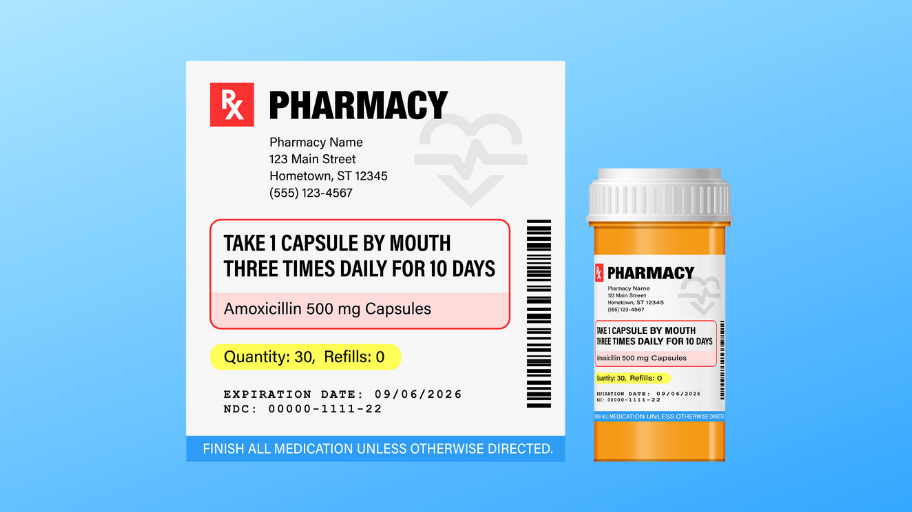
Reading a prescription medication label doesn’t require a pharmacy degree, but it does require knowing where to look. Here’s a plain-English walkthrough of what matters and why.
The Basics
These details make sure the medication is actually meant for you.
- Patient name: Double-check it, especially if multiple people in your household take prescriptions.
- Drug name: Often listed as a generic name (e.g., atorvastatin) and sometimes followed by a brand name (e.g., Lipitor).
- Strength: How much drug is in each tablet, capsule, or mL (e.g., 10 mg).
Zoom In
Focus on the directions (this is a big one)! This section tells you how to take the drug safely.
- Dose: How much to take each time.
- Frequency: How often (once daily, twice daily, every 8 hours).
- Route: How it enters your body—by mouth, injection, inhalation, etc.
- Special instructions: “Take with food”, “Do not crush or chew”, “Take at bedtime”
If anything here feels unclear, ask the pharmacist. Guessing is not a strategy.
Zoom Out
These details matter more than you’d think.
- Prescribing provider: Helpful if another healthcare professional needs clarification.
- Pharmacy name and phone number: Your first stop for questions or refill issues.
- Prescription number (Rx #): Speeds up refills and problem-solving.
Refills
- Refills remaining: Tells you whether you need to call your provider before you run out.
- Fill date: Useful for tracking freshness and adherence.
- Discard after date: Liquid meds especially don’t last forever.

Buyer Beware
Read the warning labels (don’t skip these)! Those bright stickers are there for a reason. They flag risks that may not be obvious from the drug name alone.
Examples include:
- “May cause drowsiness”: Some medications affect the central nervous system and can slow reaction time or impair judgment, especially when driving or operating machinery.
- “Avoid alcohol”: Alcohol can intensify side effects like drowsiness, dizziness, or liver toxicity. In some cases, mixing with alcohol can be dangerous or even life-threatening.
- “Finish all medication”: Stopping treatment early—even if you feel better—can allow the illness to return or worsen. For antibiotics, it can also promote drug-resistant infections.
- “Protect from light” or “Refrigerate”: Some drugs break down when exposed to light or heat, reducing their effectiveness.
Fine Print
Some labels include:
- Generic substitution notes
- Storage instructions
- Controlled substance warnings
And remember, the label is only part of the story. Many prescriptions also come with a Medication Guide—that folded handout with side effects, interactions, and when to call your doctor. It’s worth a read.
Bottom Line
A prescription label is a safety document, not just a sticker. Read it every time—even for refills—and when something doesn’t make sense, your pharmacist is your fastest, friendliest translator.
Career Moves
If a two-inch pharmacy label feels complicated, imagine the data behind it! Our Drug Development Executive Certification breaks down FDA expectations, risk management, and labeling decisions—no science background required. Move your career forward and sign up today!

Biotech Primer is your go-to source for interactive training across the biotechnology, pharmaceutical, molecular diagnostics, and medical device sectors. Explore a range of in-depth biotech courses designed to deepen your understanding of key principles and applications in the field.
Learn More